
Week 9
Step Four Worksheet

I will now read Step 4 worksheet, followed by How It Works, second paragraph from page 64 to page 71. Step 4: Made a searching and fearless moral inventory of ourselves. Resentment, anger.
Therefore, we started upon a personal inventory. This is Step 4. First, we searched out the flaws in our makeup which caused our failure. Resentment is the "number one offender" (page 64, Big Book). Having just read Chapter 5, How It Works, now it's our turn to list our resentments. Continue to work on another page if you run out of room on this one.
I'm resentful at: People, institutions, principles.
The cause: Why we were angry.
Affects my:
Self-esteem (fear)
Security
Pocketbook (fear)
Pride (ego)
Personal relations
Sex relations
Ambitions
Jog My Memory List: I'm resentful at: family members, schoolmates, religion, churches, AA group members, boyfriend, girlfriend, employer, fellow employees, jails, police, business, friends, landlord, myself, car drivers.
The cause: Being an alcoholic, withholding sex, being rejected, took the kids away, being unreasonable, lazy, having no communication, threatens to leave marriage, cheating, criticizes and nags constantly, threatens firing, thinks they are better than me.
Mastering Resentment
If we were to live, we had to be free of anger. The grouch and the brainstorm were not for us. They may be the dubious luxury of normal men, but for alcoholics, these things are poison. We turned back to the list, for it held the key to the future. We were prepared to look at it from an entirely different angle.
We began to see that the world and its people really dominated us. In that state, the wrongdoing of others, fancied or real, had power to actually kill. How could we escape? We saw that these resentments must be mastered, but how? We could not wish them away any more than our addictions.
This was our course: We realized that the people who wronged us were perhaps spiritually sick. Though we did not like their symptoms and the way they disturbed us, they, like ourselves, were sick too. We ask God to help us show them the same tolerance, pity, and patience that we would cheerfully grant a sick friend.
When a person offended, we said to ourselves, "This is a sick man. How can I be helpful to him? Thy will be done." We avoid retaliation or argument. We wouldn't treat sick people that way. If we do, we destroy our chance of being helpful. We cannot be helpful to all people, but at least God will show us how to take a kindly and tolerant view of each and every one.
(Now, transfer the above names to the Step 8 list, which is on page 5, and list your faults. Do this next, before page 2.)
Fear
Fear. We reviewed our fears thoroughly. We put them on paper. Have you ever had these fears, going all the way back to childhood?
Fear of airplane travel, insanity, or sex because I won't measure up.
Fear of children and their unpredictability.
Fear of rejection in social situations (talking to the opposite sex or asking them out).
Fear of religion, higher powers, or gambling.
Fear of dentists, doctors, growing old, or dying.
Fear of losing friends or financial insecurity.
Fear of addictions not working anymore or not being able to stay sober.
Fear of being alone or the dark.
Fear of losing something I've got or not getting what I want.
Fear of a partner cheating or getting caught cheating.
Fear of success, failure, disease, public speaking, or the future.
Fear of the past catching up with me.
Continue to add more fears that affect you. Keep listing fears on another piece of paper if you have run out of room here. If any names of people come up as part of your fear list, transfer them to Step 8 list on page 5.
Sex Problems
Sex problems. Above all, we tried to be sensible in this issue. We do not want to be the arbiter of anyone's sex conduct. We all have sex problems. We reviewed our conduct over years past. Where were we at fault? What should we have done instead? We got this all down on paper and looked at it (Pages 68 and 69).
(Please note that these examples below are not in the Big Book.) Whom had we hurt? Husband, wife, boyfriend, girlfriend, or ex-partners.
Were we: 1. Selfish, 2. Dishonest, or 3. Inconsiderate?
Did we arouse: 4. Jealousy, 5. Suspicion, or 6. Bitterness?
Examples: Staying out late without a phone call; only having sex when I want to; flirting with others while in a relationship.
Now it is your turn to review your conduct. Start by listing names of every person you have been in a relationship with, no matter how casual or serious, and mark down the numbers where you were selfish, dishonest, and inconsiderate. Then finish this inventory in the privacy of your own home and write in detail how you were selfish, dishonest, and inconsiderate.
The Step 8 List and Our Faults
Once you have completed this inventory, transfer the names to the Step 8 list on page 5. Referring to our list again, putting out of our minds the wrongs others had done, we resolutely looked for our own mistakes. Where had we been selfish, dishonest, self-seeking, and frightened?
Though a situation had not been entirely our fault, we tried to disregard the other person involved entirely. Where were we to blame? The inventory was ours, not the other man's. When we saw our faults, we listed them. We placed them before us in black and white. We admitted our wrongs honestly and were willing to set these matters straight (Page 67).
Examples of our faults: 1. Character assassination
2. Having expectations
3. Running away
4. Rejection
5. Broken promises
6. Lying, stealing, cheating
7. Using money to manipulate
8. Keeping children away from a partner
9. Stopping communication/isolation
10. Poor response to criticism
11. Using sex to get what I want
12. Starting arguments
13. Using addictions
14. Thinking you are better than others
15. Holding onto resentments
The Goal of Step 4
Once you have completed Step 4, the goal is to show you that you have the problem inside of you, but you also have the answer. The names that you have listed are not your problem. Your problem is your reaction to them. This selfish and self-centered reaction is your alcoholism and the root of your troubles.
Addictions are used to treat alcoholism; however, the side effects become too great. Another goal is to show you how intolerant you are to anything and everything that disturbs your ego. The Big Book tells us that "love and tolerance of others is our code" (page 84). But in order to learn how to put that code into practice, you have to move forward with the rest of this program.
Remember that as part of your Step 3, you agreed to work Steps 4 through 9 to recreate your life, and Steps 10 through 12 to give you the tools necessary to live without addictions. Now that you have your inventory in black and white, you are on your way. Schedule your Fifth Step at once. Admit to God, yourself, and another human being the exact nature of your wrongs.
Big Book Text: Chapter 5 (Pages 64–71)
Therefore, we started upon a personal inventory. This was Step Four. A business which takes no regular inventory usually goes broke. Taking commercial inventory is a fact-finding and a fact-facing process. It is an effort to discover the truth about the stock-in-trade. One object is to disclose damaged or unsalable goods, to get rid of them promptly and without regret. If the owner of the business is to be successful, he cannot fool himself about values.
We did exactly the same thing with our lives. We took stock honestly. First, we searched out the flaws in our makeup which caused our failure. Being convinced that self, manifested in various ways, was what had defeated us, we considered its common manifestations.
Resentment is the "number one" offender. It destroys more alcoholics than anything else. From it stem all forms of spiritual disease, for we have been not only mentally and physically ill, we have been spiritually sick. When the spiritual malady is overcome, we straighten out mentally and physically.
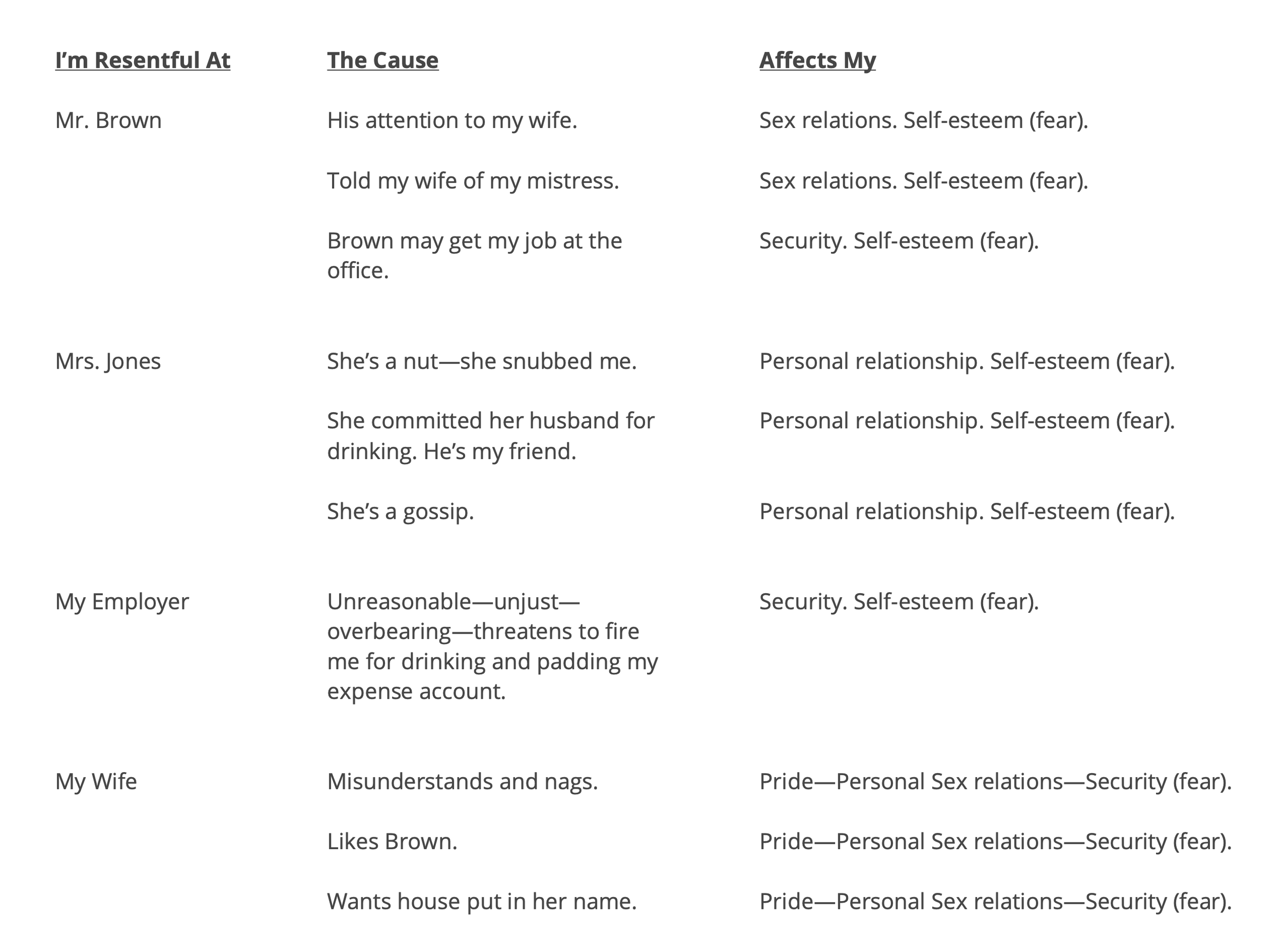
In dealing with resentments, we set them on paper. We listed people, institutions, or principles with whom we were angry. We asked ourselves why we were angry. In most cases, it was found that our self-esteem, our pocketbooks, our ambitions, our personal relationships (including sex) were hurt or threatened. So we were sore. We were burned up.
On our grudge lists, we set opposite each name our injuries. Was it our self-esteem, our security, our ambitions, our personal or sex relations which had been interfered with? We were usually as definite as this example:
The Fatality of Resentment
We went back through our lives. Nothing counted but thoroughness and honesty. When we were finished, we considered it carefully. The first thing apparent was that this world and its people were often quite wrong. To conclude that others were wrong was as far as most of us ever got. The usual outcome was that people continued to wrong us, and we stayed sore.
But the more we fought and tried to have our own way, the worse matters got. It is plain that a life which includes deep resentment leads only to futility and unhappiness. To the precise extent that we permit these, do we squander the hours that might have been worthwhile.
But with the alcoholic, whose hope is the maintenance and growth of a spiritual experience, this business of resentment is infinitely grave. We found that it is fatal. For when harboring such feelings, we shut ourselves off from the sunlight of the Spirit. The insanity of alcohol returns and we drink again. And with us, to drink is to die.
The Solution for Resentment
If we were to live, we had to be free of anger. The grouch and the brainstorm are not for us. They are poison. We began to see that the wrongdoing of others, fancied or real, had power to actually kill. How could we escape?
We realized that the people who wronged us were perhaps spiritually sick. We ask God to help us show them the same tolerance, pity, and patience that we would cheerfully grant a sick friend. When a person offended, we said to ourselves, "This is a sick man. How can I be helpful to him? God save me from being angry. Thy will be done."
We avoid retaliation or argument. We wouldn't treat sick people that way. If we do, we destroy our chance of being helpful. Referring to our list again, putting out of our minds the wrongs others had done, we resolutely looked for our own mistakes. Where had we been selfish, dishonest, self-seeking, and frightened? The inventory was ours, not the other man's. When we saw our faults, we listed them. We placed them before us in black and white.
Fear: The Corroding Thread
Notice that the word "fear" is bracketed alongside the difficulties with Mr. Brown, Miss Jones, the employer, and the wife. This short word somehow touches about every aspect of our lives. It was an evil and corroding thread; the fabric of our existence was shot through with it.
We reviewed our fears thoroughly. We put them on paper, even though we had no resentment in connection with them. We asked ourselves why we had them. Wasn't it because self-reliance failed us? Self-reliance was good as far as it went, but it didn't go far enough.
Perhaps there is a better way. We think so. For we are now on a different basis—the basis of trusting and relying upon God. We trust infinite God rather than our finite selves. We are in the world to play the role He assigns. Just to the extent that we do as we think He would have us, and humbly rely on Him, does He enable us to match calamity with serenity.
We never apologize to anyone for depending upon our Creator. We can laugh at those who think spirituality the way of weakness. Paradoxically, it is the way of strength. At once, we commence to outgrow fear.
Sex: Shaping a Sane Ideal
Now about sex. Many of us needed an overhauling there. But above all, we try to be sensible. It's so easy to get way off track. Here we find human opinions running to extremes. One set of voices cry that sex is a lust of our lower nature; the other school would have us all on a straight pepper diet.
We do not want to be the arbiter of anyone's sex conduct. We all have sex problems. We'd hardly be human if we didn't. We reviewed our own conduct over the years past. Where have we been selfish, dishonest, or inconsiderate? Whom had we hurt? Did we unjustifiably arouse jealousy, suspicion, or bitterness?
We got this all down on paper and looked at it. In this way, we tried to shape a sane and sound ideal for our future sex life. We subjected each relation to this test: Was it selfish or not? We ask God to mold our ideals and help us to live up to them. We remembered always that our sex powers were God-given and therefore good—neither to be used lightly or selfishly, nor to be despised and loathed.
Whatever our ideal turns out to be, we must be willing to grow toward it. We must be willing to make amends where we have done harm. If sex is very troublesome, we throw ourselves the harder into helping others. We think of their needs and work for them. This takes us out of ourselves. It quiets the imperious urge when to yield would mean heartache.
Summary
If we have been thorough about our personal inventory, we have written down a lot. We have begun to learn tolerance, patience, and goodwill toward all men, even our enemies, for we look on them as sick people.
In this book you read again and again that faith did for us what we could not do for ourselves. We hope you are convinced now that God can remove whatever self-will has blocked you off from Him. You have swallowed and digested some big chunks of truth about yourself.
 Daily Readings